Boost your SEO performance with professional SEO services designed to improve search rankings, increase organic traffic, attract qualified leads, and grow your business online.
Search is one of the most powerful ways businesses can connect with potential customers.
When people need a product, service, solution, answer, or recommendation, one of the first things they often do is search for information online.
That makes search visibility an important part of digital marketing.
But SEO is often misunderstood.
Some businesses believe SEO is simply about adding keywords to a website. Others believe that ranking on Google is guaranteed if they publish enough blog posts. Some assume that paid advertising and organic search are the same thing.
The reality is much more complex.
Modern SEO involves understanding search intent, creating useful content, maintaining a technically strong website, building authority, improving user experience, and adapting to changes in how people search.
Artificial intelligence is also changing the search landscape.
Because of these changes, businesses need to understand not only how traditional SEO works, but also how search behavior is evolving.
This guide covers eight important areas:
- SEO myths you should stop believing
- How Google decides which websites rank
- An on-page SEO checklist
- Local SEO and getting found by nearby customers
- Keywords that actually matter
- SEO mistakes that can hurt your website
- Organic traffic vs paid traffic
- How AI is changing search
1. SEO Myths You Should Stop Believing
SEO has existed for many years, but outdated ideas continue to influence how businesses approach it.
Let’s separate some common myths from reality.

Myth 1: SEO Is Just About Keywords
Keywords are important, but SEO is much more than keyword placement.
use strategic search optimization to improve rankings, increase organic traffic, and strengthen your website’s search visibility.
- What the page is about
- What the user is looking for
- Whether the content satisfies the search intent
- How topics relate to one another
- Whether the website provides useful information
- Whether the page offers a good experience
For example, repeating the phrase “digital marketing agency” dozens of times does not automatically make a webpage valuable.
A better approach is to create useful content that naturally discusses:
- Digital marketing services
- SEO
- Content marketing
- Social media
- Paid advertising
- Lead generation
- Analytics
- Conversion optimization
The goal is not to write for a keyword.
The goal is to write for a person who has a specific need.
Myth 2: More Content Always Means Better SEO
Publishing more content does not automatically improve search performance.
Imagine two websites .Search visibility
Website A publishes 500 short articles that provide little original value.
Website B publishes 50 detailed resources that genuinely answer customer questions.
More pages do not automatically mean more visibility.
Quality, relevance, usefulness, structure, and authority matter.
The better question is:
“Does this content provide something valuable that our audience actually needs?”
Myth 3: SEO Gives Immediate Results
SEO is generally a long-term marketing activity.
A new website may need time to:
- Be crawled
- Be indexed
- Establish topical relevance
- Build authority
- Earn links and mentions
- Generate user engagement
- Demonstrate consistent quality
Results can vary significantly depending on the website, industry, competition, content quality, technical condition, and other factors.
Therefore, businesses should avoid treating SEO Search visibility as an overnight growth strategy.
Myth 4: Ranking Number One Is the Only Goal
A high ranking can be valuable, but ranking alone is not the ultimate business objective.Our SEO services use strategic search optimization to improve rankings, increase organic traffic, and strengthen your website’s search visibility.
Imagine a page ranking highly for a keyword that generates thousands of visitors but almost no customers.
Another page might receive less traffic but generate highly qualified leads.
From a business perspective, the second page may be more valuable.
SEO should therefore connect to broader goals such as:
- Qualified traffic
- Leads
- Enquiries
- Sales
- Brand visibility
- Customer acquisition
The goal isn’t simply to attract visitors.
The goal is to attract the right visitors.
2. How Google Decides Which Websites Rank
Google does not simply maintain one permanent list of websites from best to worst.
Search systems evaluate pages in relation to individual queries.
When someone searches for something, many factors can influence which results are displayed.
These include relevance, content quality, technical accessibility, context, authority, location, and the nature of the search itself.
Step 1: Crawling
Search engines use automated systems to discover webpages.
Links between pages help search engines discover new content.
Technical issues can sometimes prevent important pages from being crawled effectively.
Step 2: Indexing
After discovering a page, a search engine may analyze and store information about it in its index.
Not every webpage is necessarily indexed. Our SEO services use strategic search optimization to improve rankings, increase organic traffic, and strengthen your website’s search visibility.
Factors such as technical accessibility, duplicate content, canonicalization, quality, and other signals can influence indexing.
Step 3: Understanding the Query
Search engines need to understand what the user means.
Consider:
“Apple”
This could refer to:
- The fruit
- The technology company
- A product
- A location or other context
Search systems use context and other signals to interpret queries.
This is why modern SEO should focus on meaning and search intent, not simply exact keyword matching.
Step 4: Matching Relevant Content
The search engine identifies webpages that may be relevant to the query.
For example, someone searching:
“how to improve website speed”
is likely looking for educational information.
Someone searching:
“buy running shoes online”
has a different intent.
The content needs to match the reason behind the search.
3. On-Page SEO Checklist
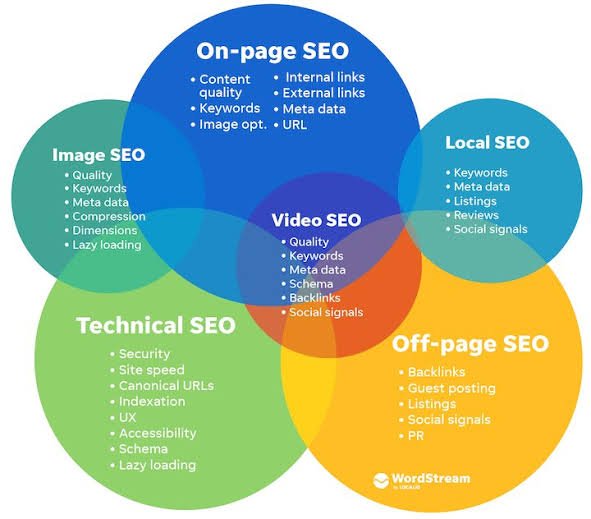
On-page SEO refers to optimization performed on the webpage itself.
A useful checklist includes the following.
Title Tag
Create a clear title that accurately describes the page.
For example:
Weak:
“Home”
Better:
“Digital Marketing Agency for Business Growth”
The title should communicate the page’s purpose clearly.
Meta Description
A meta description can summarize what users can expect from a webpage.
It should be:
- Relevant
- Clear
- Useful
- Written for humans
It should encourage qualified users to understand what the page offers.
Headings
Use headings to organize content.
A logical structure might be:
H1: Digital Marketing Services
H2: SEO Services
H2: Social Media Marketing
H2: Paid Advertising
H2: Content Marketing
H2: Why Choose Our Agency?
Good headings make content easier to scan.
URL Structure
Keep URLs understandable.
For example:
example.com/seo-services
is generally clearer than:
example.com/page?id=73829
A clean URL communicates the topic of the page.
Internal Linking
Connect relevant pages together.
For example:
An article about SEO could link to:
- SEO services
- Keyword research
- Local SEO
- Technical SEO
- SEO analytics
Internal links can help users discover related information and help search engines understand relationships between pages.
Image Optimization
Images should support the content rather than simply decorate the page.
Consider:
- Descriptive filenames
- Appropriate alternative text
- Suitable image dimensions
- Efficient file sizes
- Relevant placement
Content Quality
The content should:
- Answer the user’s question
- Be accurate
- Be readable
- Provide sufficient context
- Avoid unnecessary repetition
- Demonstrate appropriate expertise
Mobile Experience
A large percentage of online activity happens on mobile devices.
Your website should therefore be easy to use on:
- Smartphones
- Tablets
- Laptops
- Desktop computers
Navigation, buttons, text, images, and forms should work properly across screen sizes.
4. Local SEO: Get Found by Customers Near You
Local SEO focuses on improving visibility for searches connected to a specific geographic area.
Examples include:Our SEO services use strategic search optimization to improve rankings, increase organic traffic, and strengthen your website’s search visibility.
“digital marketing agency near me”
“SEO agency in Hyderabad”
“best salon near me”
“dentist in Bangalore”
Local search is especially important for businesses that serve specific locations.
These can include:
- Restaurants
- Clinics
- Hotels
- Salons
- Real estate companies
- Local retailers
- Professional services
- Agencies
- Home services
How to Improve Local SEO
Keep Business Information Consistent
Make sure important information is accurate across relevant platforms.
This can include:
- Business name
- Address
- Phone number
- Website
- Opening hours
- Service information
Consistency helps customers and search systems understand your business.
Create Location-Relevant Content
Businesses serving multiple locations can create genuinely useful location-specific pages where appropriate.
For example:
Digital Marketing Services in Hyderabad
could discuss:
- Local market considerations
- Services offered
- Industries served
- Local customer needs
- Relevant case studies
The content should provide actual value rather than simply repeating a city name.
Collect Genuine Reviews
Customer reviews can play an important role in local business discovery and customer decision-making.
Encourage genuine customers to share their experiences.
Avoid creating fake reviews or manipulating ratings.
Build Local Relevance
Participating in relevant local activities, publications, partnerships, and community initiatives can help establish a stronger local presence.
Local SEO is not just about inserting a location into keywords.
It is about demonstrating that your business genuinely serves that community.
5. Keywords That Actually Matter
Keyword research remains a fundamental part of SEO.
But not every keyword is equally valuable.
Businesses often make the mistake of chasing keywords with extremely high search volume.
High volume can be attractive.
But relevance and intent are equally important.
Consider these examples:
“marketing”
This is extremely broad.
Now compare:
“SEO agency for real estate companies”
This is more specific.
The second keyword may have less search volume, but it can reveal much stronger commercial intent.
Types of Keywords
Informational Keywords
Users want information.
Examples:
- What is SEO?
- How does Google Ads work?
- What is content marketing?
Commercial Keywords
Users are researching options.
Examples:
- Best SEO agency
- SEO services comparison
- Digital marketing agency reviews
Transactional Keywords
Users are closer to taking action.
Examples:
- Hire SEO agency
- Buy website design service
- Book digital marketing consultation
Local Keywords
Users include a geographic element.
Examples:
- SEO agency in Hyderabad
- Digital marketing agency near me
- Local SEO services Bangalore
A strong SEO strategy can address different stages of the customer journey.
Search Intent Matters More Than Keyword Volume Alone
Before targeting a keyword, ask:
What does the person actually want?
If someone searches:
“how to do SEO”
they may want a guide.
If someone searches:
“SEO agency pricing”
they may be comparing providers.
If someone searches:
“hire SEO agency”
they may be ready to contact a company.
The content should match the intent.
6. SEO Mistakes That Can Hurt Your Website
Even businesses investing in SEO can make avoidable mistakes.
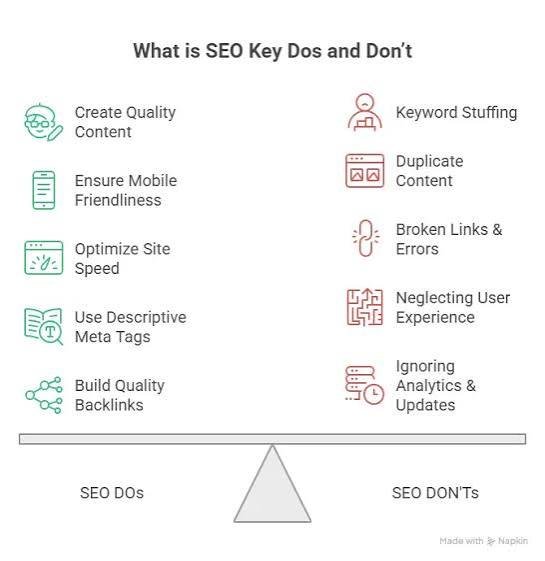
Mistake 1: Keyword Stuffing
Repeating keywords unnaturally can make content difficult to read and can be counterproductive.
Use relevant terms naturally.
Mistake 2: Duplicate Content
Publishing substantially duplicated pages can make it harder to establish which page should be shown for a particular topicCreate distinct, useful resources whenever possible.
Mistake 3: Ignoring Technical SEO
A beautiful website can still have technical problems.
Issues may include:
- Broken links
- Poor crawlability
- Incorrect redirects
- Slow pages
- Indexing problems
- Poor mobile usability
Technical health should be part of ongoing SEO maintenance.
Mistake 4: Writing for Algorithms Instead of People
If a page sounds robotic, repetitive, or unnatural, users may leave quickly.
Create content that people actually want to read.
Mistake 5: Ignoring Search Intent
A webpage can be well optimized but still fail to satisfy the user’s purpose.
For example, if someone searches for pricing and the page provides only a general company introduction, the intent mismatch can reduce its usefulness.
Mistake 6: Buying Low-Quality Links
Not all backlinks are valuable.
Artificial or manipulative link-building practices can create risks.
Focus on earning relevant mentions and links through valuable content, partnerships, digital PR, and genuine industry relationships.
Mistake 7: Forgetting Conversion Optimization
Traffic without conversions does not automatically create business growth.
- Contact you
- Request a quote
- Book a consultation
- Purchase
- Subscribe
- Learn more
SEO brings visibility.
Conversion optimization helps turn that visibility into business outcomes.
7. Organic Traffic vs Paid Traffic
Organic and paid traffic are two different approaches to attracting visitors.
Organic Traffic
Organic traffic comes from unpaid search results and other unpaid discovery channels.
SEO is a major way businesses increase organic search traffic.
Advantages can include:
- Long-term visibility potential
- No direct payment for every click
- Increased brand discovery
- Compounding content value
- Strong relevance for informational searches
However, SEO requires ongoing investment in content, technical improvements, research, and maintenance.
Paid Traffic
Paid traffic comes from advertising platforms.
Businesses can pay to display ads for specific audiences, searches, placements, or campaigns.
Examples include:
- Search advertising
- Display advertising
- Social media advertising
- Video advertising
- Shopping advertising
Advantages can include:
- Faster campaign launch
- Precise targeting options
- Budget control
- Measurable campaigns
- Ability to test offers quickly
However, paid traffic generally stops when advertising spend stops.
Organic vs Paid: Which Should You Use?
This doesn’t have to be an either/or decision.
Many businesses can use both.
For example:Our SEO services use strategic search optimization to improve rankings, increase organic traffic, and strengthen your website’s search visibility.
SEO
Build long-term organic visibility.
Paid advertising
Capture immediate demand and test campaigns.
Content
Educate potential customers.
Remarketing
Reconnect with people who previously interacted with the business.
A combined strategy can create multiple paths to customer acquisition.
8. How AI Is Changing Search
Artificial intelligence is one of the biggest developments in modern search.
AI can help search systems understand:
- Natural language
- Context
- User intent
- Relationships between concepts
- Complex questions
This is changing how users interact with search.
Instead of:
“SEO tips”
someone might ask:
“What SEO strategy should a small B2B company use if it wants to generate qualified leads rather than just increase website traffic?”
This is a much richer query.
It contains context and a specific objective.
From Keywords to Conversations
Traditional SEO often starts with keyword research.
AI-powered search encourages marketers to think more broadly about conversations.
A user may ask:
“What is SEO?”
Then:
“How long does it take?”
Then:
“Would it work for my local business?”
Then:
“What should I budget?”
The user is no longer making isolated searches.
They are having a conversation.
This means content should answer follow-up questions and cover topics comprehensively.
AI and Content Creation
AI can assist marketers with:
- Research
- Brainstorming
- Outlining
- Content drafts
- Data analysis
- Content repurposing
- Reporting
- Keyword clustering
- Competitor research
But AI-generated content should not simply be published without review.
Human oversight remains important for:
- Accuracy
- Originality
- Brand voice
- Expertise
- Fact checking
- Strategy
- Customer relevance
The best approach is not:
AI instead of humans.
It is:
AI + human expertise.
SEO in the Age of AI
AI does not mean SEO is dead.
It means search marketing is evolving.
Traditional SEO remains important because websites, pages, content, links, technical infrastructure, and structured information remain part of the broader search ecosystem.
At the same time, businesses should prepare for:
- Conversational search
- Answer engines
- Generative search
- AI-powered recommendations
- Multimodal search
- Increasingly personalized discovery
The businesses that adapt their content strategy can better respond to these changes.
The Future of Search Marketing
The future of SEO is likely to involve a combination of:
Traditional Search
Answer Engines
Generative AI
Local Discovery
Social Search
Video Search
Brand Authority
This means businesses should stop thinking about SEO as a single activity.
SEO is becoming part of a broader search visibility strategy.
The Modern SEO Framework
A practical modern framework can look like this:
1. Technical Foundation
Build a website that search engines can access and users can navigate easily.
2. Search Intent
Understand what your audience is actually looking for.
3. Keyword Strategy
Identify relevant terms across different stages of the customer journey.
4. Helpful Content
Create useful resources that solve real problems.
5. On-Page Optimization
Improve titles, headings, URLs, internal links, images, and page structure.
6. Local Visibility
Build a strong presence for location-based searches where relevant.
7. Authority
Develop genuine expertise and credibility.
8. Conversion
Turn visitors into enquiries, customers, subscribers, or other meaningful actions.
9. AI Readiness
Create clear, comprehensive, trustworthy information that works across evolving search experiences.
10. Continuous Improvement
Monitor performance and improve based on data and changing user behavior.
Final Thoughts
SEO is no longer simply about putting keywords on a webpage and waiting for Google to rank it.
Modern search marketing is about understanding people.
What are they searching for?
Why are they searching?
What problem are they trying to solve?
What information do they need?
What would make them trust a business?
What would make them take action?
These questions are at the heart of effective SEO.
Traditional SEO provides the foundation.
On-page optimization helps search engines and users understand individual pages.
Local SEO helps businesses become visible to relevant nearby audiences.
Keyword research identifies the language and intent behind searches.
Organic traffic can build long-term visibility.
Paid traffic can provide targeted opportunities through advertising.
And AI is transforming how people ask questions and discover information.
The future of search belongs to businesses that can combine technical excellence, useful content, strong brand authority, customer understanding, and continuous adaptation.
Don’t focus only on ranking.
Focus on relevance.
Don’t focus only on traffic.
Focus on qualified traffic.
Don’t focus only on keywords.
Focus on intent.
Don’t create content simply because search engines exist.
Create content because your customers need answers.
And don’t treat AI as a replacement for marketing strategy.
Use it as a tool that helps marketers research, analyze, create, and improve—while human expertise provides the judgment, creativity, and authenticity behind the strategy.
SEO Is Changing. Search Is Changing. Your Strategy Should Too.
Be visible.
Be relevant.
Be useful.
Be trustworthy.
And most importantly, be where your customers are searching.